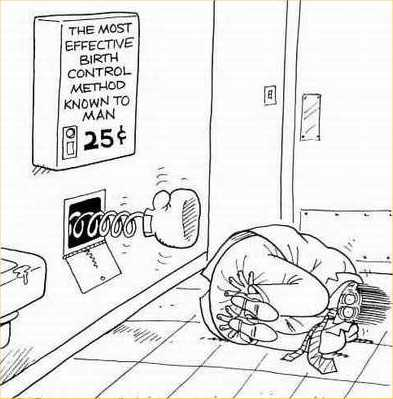
THE MOST EFFECTIVE BIRTH CONTROL METHOD KNOWN TO MAN
25¢
Ironic humor, jokes, memes, and punchlines sorted by emotional damage level from Chaotic Meh — organized so the algorithm can pretend this place has adult supervision.
One day, a sign appeared in an office window. It read: “Help wanted. Must type seventy words a minute. Must be computer literate. Must be bilingual. An equal opportunity employer.” A dog ambling down the street saw the sign, walked in, and applied for the job.
The office manager said, “I can’t hire a dog for this job.”
The dog pointed to the line: “An equal opportunity employer.”
So the manager said, “OK, take this letter and type it.”
The dog went off to the word processor and returned a minute later with the finished letter, perfectly formatted.
The manager said, “Here’s a problem. Write a computer program for it and run it.”
Fifteen minutes later, the dog came back with the correct answer.
The manager still wasn’t convinced. “I can’t hire a dog for this position. You’ve got to be bilingual.”
The dog looked up at the manager and said, “Meow.”
Interviewer: Why is a thicker conductor necessary to carry a current in A.C. as compared to D.C.?
Student: An AC current goes up and down (drawing a sinusoid) and requires more space inside the wire, so the wire has to be thicker.
Interviewer: How will you tell if that wall outlet carries AC or DC?
Student: I will put my finger in. If it is pushed away, it is DC. If it gets stuck, it was AC.
Interviewer: How will you reverse direction of an induction motor?
Student: I will remove the four bolts at the base, turn the motor around, and put back the bolts.
Interviewer: How do you start a synchronous motor?
Student: Vrrrrrrrmmmmmmmmmmmmmmmmmmm (in rising pitch)
Interviewer: Stop! Stop!
Student: rrrrrrrmmmmmmmmmmmmmmmmmmmm (in falling pitch)
Interviewer: How do you limit surge current within an integrated circuit?
Student: By using a miniature circuit breaker.
Interviewer: Why does a capacitor block DC but allow AC to pass through?
Student: See, a capacitor is like this —“~~”—, OK. DC comes straight, like this ——————————, and the capacitor stops it. But AC goes UP, DOWN, UP, DOWN and jumps right over the capacitor!
Interviewer: What is a step-up transformer?
Student: A transformer that is put on top of electric poles.
Interviewer (smiling): And then what is a step-down transformer?
Student (hesitantly): Uh — a transformer that is put in the basement or in a pit?
Interviewer (pouncing): Then what do you call a transformer that is installed on the ground?
Interviewer (impatiently): Well?
Student (triumphantly): A stepless transformer, sir!
A magazine recently ran a “Dilbert Quotes” contest. The writers were looking for people to submit quotes from their real-life Dilbert-type managers. Here are some of the submissions:
1. As of tomorrow, employees will only be able to access the building using individual security cards. Pictures will be taken next Wednesday and employees will receive their cards in two weeks. (This was the winning entry; Fred Dales at Microsoft Corporation in Redmond, WA)
2. What I need is a list of specific unknown problems we will encounter. (Lykes Lines Shipping)
3. How long is this Beta guy going to keep testing our stuff? (Programming intern, Microsoft IIS Development team)
4. E-mail is not to be used to pass on information or data. It should be used only for company business. (Accounting Mgr., Electric Boat Company)
5. This project is so important, we can’t let things that are more important interfere with it. (Advertising/Mktg. Mgr., UPS)
6. Doing it right is no excuse for not meeting the schedule. No one will believe you solved this problem in one day! We’ve been working on it for months. Now, go act busy for a few weeks and I’ll let you know when it’s time to tell them. (R&D Supervisor, Minnesota Mining & Manufacturing / 3M Corp.)
7. My boss spent the entire weekend retyping a twenty-five-page proposal that only needed corrections. She claims the disk I gave her was damaged and she couldn’t edit it. The disk I gave her was write-protected. (CIO of Dell Computers)
8. Quote from the boss: “Teamwork is a lot of people doing what ‘I’ say.” (Mktg. executive, Citrix Corporation)
9. My sister passed away and her funeral was scheduled for Monday. When I told my boss, he said she died so that I would have to miss work on the busiest day of the year. He then asked if we could change her burial to Friday. He said, “That would be better for me.” (Shipping Executive, FTD Florists)
10. We know that communication is a problem, but the company is not going to discuss it with the employees. (AT&T Long Lines Division)
11. We recently received a memo from senior management saying, “This is to inform you that a memo will be issued today regarding the subject mentioned above.” (Microsoft, Legal Affairs Division)
12. One day my boss asked me to submit a status report to him concerning a project I was working on. I asked him if tomorrow would be soon enough. He said, “If I wanted it tomorrow, I would have waited until tomorrow to ask for it!” (New Business Mgr., Hallmark Cards)
13. As director of communications, I was asked to prepare a memo reviewing our company’s training programs and materials. In the body of the memo one of the sentences mentioned the “pedagogical approach” used by one of the training manuals. The day after I routed the memo to the executive committee, I was called into the HR Director’s office, and was told that the executive VP wanted me out of the building by lunch. When I asked why, I was told that she wouldn’t stand for “perverts” (pedophiles?) working in her company. Finally he showed me her copy of the memo, with her demand that I be fired, with the word “pedagogical” circled in red. The HR Manager was fairly reasonable, and once he looked the word up in his dictionary and made a copy of the definition to send to my boss, he told me not to worry. He would take care of it. Two days later a memo to the entire staff came out, directing us that no words which could not be found in the local Sunday newspaper could be used in company memos. A month later, I resigned. In accordance with company policy, I created my resignation letter by pasting words together from the Sunday paper. (Taco Bell Corporation)
14. This gem is the closing paragraph of a nationally circulated memo from a large communications company: “Lucent Technologies is endeavoringly determined to promote constant attention on current procedures of transacting business focusing emphasis on innovative ways to better, if not supersede, the expectations of quality!”
When you take a long time, you’re slow.
When your boss takes a long time, he’s thorough.
When you don’t do it, you’re lazy.
When your boss doesn’t do it, he’s too busy.
When you make a mistake, you’re an idiot.
When your boss makes a mistake, he’s only human.
When doing something without being told, you’re overstepping your authority.
When your boss does the same thing, that’s initiative.
When you take a stand, you’re being bull-headed.
When your boss does it, he’s being firm.
When you overlook a rule of etiquette, you’re being rude.
When your boss skips a few rules, he’s being original.
When you please your boss, you’re arse-creeping.
When your boss pleases his boss, he’s being cooperative.
When you’re out of the office, you’re wandering around.
When your boss is out of the office, he’s on business.
When you have one too many drinks at a social, you’re a drunken bum.
When your boss does the same, he appreciated women.
When you’re on a day off sick, you’re always sick.
When your boss takes a day off sick, he must be very ill.
When you apply for leave, you must be going for an interview.
When your boss applies for leave, it’s because he’s overworked.
Memo from Director General to Manager:
Today at 11 o’clock there will be a total eclipse of the sun. This is when the sun disappears behind the moon for two minutes. As this is something that cannot be seen every day, time will be allowed for employees to view the eclipse in the parking lot.
Staff should meet in the lot at ten to eleven, when I will deliver a short speech introducing the eclipse and giving some background information. Safety goggles will be made available at a small cost.
Memo from Manager to Department Head:
Today at ten to eleven, all staff should meet in the car park. This will be followed by a total eclipse of the sun, which will appear for two minutes. For a moderate cost, this will be made safe with goggles.
The Director General will deliver a short speech beforehand to give us all some background information. This is not something that can be seen every day.
Memo from Department Head to Floor Manager:
The Director General will today deliver a short speech to make the sun disappear for two minutes in the form of an eclipse. This is something that cannot be seen every day, so staff will meet in the car park at ten or eleven. This will be safe, if you pay a moderate cost.
Memo from Floor Manager to Supervisor:
Ten or eleven staff are to go to the car park, where the Director General will eclipse the sun for two minutes. This doesn’t happen every day. It will be safe, but it will cost you.
Memo from Supervisor to Staff:
Some staff will go to the car park today to see the Director General disappear. It is a pity this doesn’t happen every day.
The Americans and the Japanese decided to engage in a competitive boat race. Both teams practiced hard and long to reach their peak performance. On the big day they felt ready. The Japanese won by a mile.
Afterward, the American team was discouraged by the loss. Morale sagged. Corporate management decided that the reason for the crushing defeat had to be found, so a consulting firm was hired to investigate the problem and recommend corrective action.
The consultant’s finding: The Japanese team had eight people rowing and one person steering; the American team had one person rowing and eight people steering. After a year of study and millions spent analyzing the problem, the consulting firm concluded that too many people were steering and not enough were rowing on the American team.
So as race day neared again the following year, the American team’s management structure was completely reorganized. The new structure: four steering managers, three area steering managers, and a new performance review system for the person rowing the boat to provide work incentive.
The next year, the Japanese won by two miles. Humiliated, the American corporation laid off the rower for poor performance and gave the managers a bonus for discovering the problem.
Since I was the first to arrive at our high-tech company one morning, I answered the telephone. When the caller asked for field engineering, I explained that it was before normal business hours, but that I would help if I could. “What’s your job there?” the caller asked me.
“I’m the president,” I replied.
There was a pause. Then he said, “I’ll call back later. I need to talk to someone who knows something.”
A fellow had just been hired as the new CEO of a large high-tech corporation. The CEO who was stepping down met with him privately and presented him with three numbered envelopes. “Open these if you run up against a problem you don’t think you can solve,” he said.
Well, things went along pretty smoothly, but six months later, sales took a downturn and he was really catching a lot of heat. About at his wit’s end, he remembered the envelopes. He went to his drawer and took out the first envelope. The message read, “Blame your predecessor.”
The new CEO called a press conference and tactfully laid the blame at the feet of the previous CEO. Satisfied with his comments, the press and Wall Street responded positively, sales began to pick up and the problem was soon behind him. About a year later, the company was again experiencing a slight dip in sales, combined with serious product problems. Having learned from his previous experience, the CEO quickly opened the second envelope.
The message read, “Reorganize.” This he did, and the company quickly rebounded. After several consecutive profitable quarters, the company once again fell on difficult times.
The CEO went to his office, closed the door and opened the third envelope. The message said, “Prepare three envelopes.”
This guy walks into a bank and says to the teller at the window, “I want to open a fuckin’ checking account!”
To which the lady replied, “I beg your pardon, what did you say?”
“Listen up, dammit, I said I want to open a fuckin’ checking account right now.”
“Sir, I’m sorry but we do not tolerate that kind of language in this bank!” The teller left the window and went over to the bank manager and told him about her situation. They both returned and the manager asked, “What seems to be the problem here?”
“There’s no damn problem,” the man said. “I just won fifty million in the lottery and I want to open a fuckin’ checking account in this damn bank!”
“I see, sir,” the manager said. “And this bitch is giving you a hard time?”
